When the Metric Stays Still and the World Moves
Steps fell 56%. Effort rose 71%. Fitness barely moved. What a broken car taught me about proxies, outcome metrics, and the conditions under which a measure holds.
Looking at my activity data, I noticed that my average steps and distance were falling.
At first I thought: that can't be right.
My car broke down. Again.
So now most journeys happen on foot. Steep hills. Steps. Heavy groceries. 37 degree heat.
Subjectively, I felt like all of that extra effort should have shown up in my step count.
Then I looked at the rest of the data.
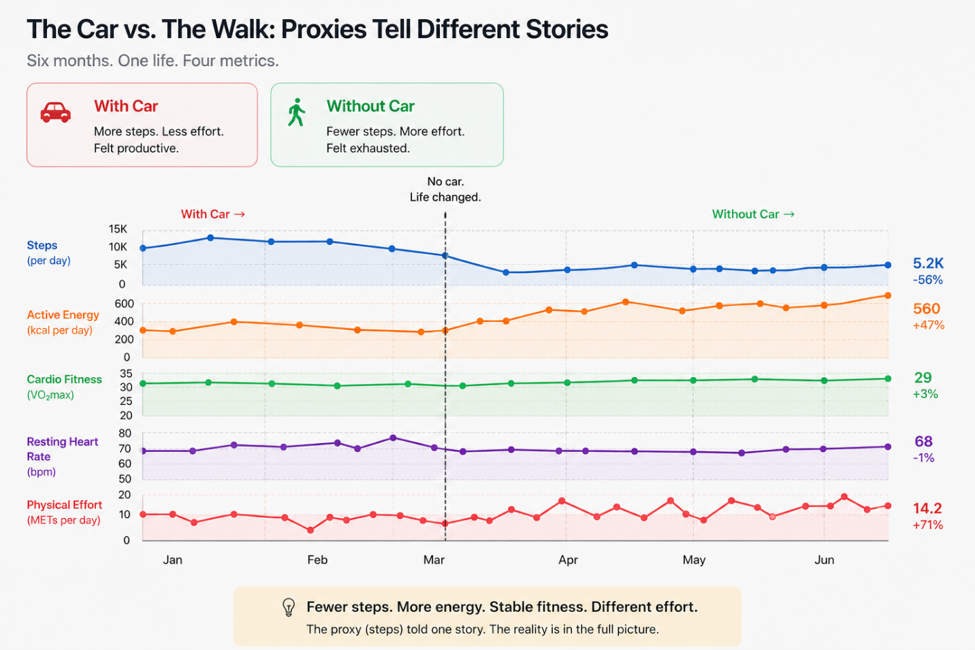
Steps: -56%. Active energy: +47%. METs: +71%. VO2 max: essentially flat.
The contradiction was immediate.
Fewer steps. More effort. Similar fitness outcome.
The metric hadn't changed at all. The context had. And with it, the meaning I attached to the number.
The proxy and what it stands for
Steps is a proxy for physical activity. A useful one. Widely available, easy to track, legible at a glance.
But a proxy is only as reliable as the relationship between what it measures and what it represents. That relationship isn't fixed. It holds under certain conditions. When those conditions change, the proxy can keep reporting confidently while the underlying reality has already moved.
For most of the period I was tracking this data, steps and activity moved together. More steps meant more movement. The proxy was stable because the conditions were stable. Flat urban terrain. A car for longer journeys. A fairly consistent pattern of daily movement.
Remove the car. Add hills. Add heat. Add load. Every step became vastly more expensive.
Steps fall 56%. Active energy rises 47%. Physical effort, measured in METs, rises 71%.
The proxy and the reality didn't just diverge. They inverted.
Not because the metric broke. Because the context it was calibrated against no longer exists.
Why we don't question the standard
Steps became the default metric not because it is the most accurate measure of physical activity. It became the default because it is the most available and the most legible.
It requires no additional interpretation. It produces a clean number. It is easy to track over time and easy to compare across days, weeks, months.
That legibility is genuinely useful. But it also insulates the metric from scrutiny. When something is easy to read and consistently available, we stop asking what it is actually measuring. We inherit it as standard. We build habits and targets around it. We use it to evaluate progress.
Economist Charles Goodhart observed that when a measure becomes a target, it ceases to be a good measure. Steps became both. The number stopped describing my activity and started shaping how I thought about it. The metric didn't just reflect behaviour. It influenced it.
And then conditions change. The metric keeps reporting. The number looks familiar. The relationship has quietly shifted.
This is not a failure of the metric. It is a failure of the assumption that the metric's meaning is stable.
What I actually wanted to measure
Steps was never the right metric for what I cared about.
What I actually wanted to know was whether I was getting fitter. Whether the effort I was putting in was translating into cardiovascular improvement. Whether the accumulated physical stress of a life without a car was building something or just grinding me down.
For that, the relevant metric is VO2 max.
And VO2 max is essentially flat.
Over six months, through a dramatic shift in daily physical context, my cardiorespiratory fitness has barely moved. Steps down 56%. Effort up 71%. Fitness outcome: unchanged.
That is not the story the intermediate metrics tell. Active energy up. METs up. The body is clearly working harder. But the outcome metric — the one that actually reflects what I was trying to achieve — hasn't responded. Not yet, at least.
The proxy metric moves dramatically and tells a clear story. The intermediate metrics move in the opposite direction and tell a different story. The outcome metric stays still and tells a third story entirely.
Which one do you act on?
It depends on what you are trying to achieve.
If the objective is energy expenditure, the intermediate metrics are most relevant. If the objective is cardiovascular fitness, VO2 max is the right focus, however imperfect. If the objective is understanding what is actually happening, you need all of them, read in context.
There is no single right answer. There is only the answer that is right for the purpose.
Between input and output
The uncertainty is not about which metric to trust. It is about whether the effort is producing the outcome.
It is possible that VO2 max is a lagging indicator and the fitness gains are coming. It is possible that carrying loads, managing heat, and navigating uneven terrain does not translate efficiently into cardiovascular improvement.
What I know is that acting on the steps data alone would have led me to conclude I was doing less. Acting on energy and METs alone would have led me to conclude I was making strong progress.
Neither reading was wrong. Both were incomplete.
The outcome metric tells me something neither of the others could: that the effort has not yet translated. That the distance between input and output is still open. That the story is not finished.
Acting before that distance closes — treating the intermediate signal as confirmation of the outcome — is where measurement goes wrong. Not because the data was bad. Because the question being answered and the question being asked were not the same thing.
When the outcome metric has assumptions of its own
But there is a further complication.
VO2 max is not directly measured by a consumer watch. It is estimated. Apple Watch calculates it from outdoor walks, runs, or hikes — but specifically on relatively flat ground, defined as less than 5% incline or decline, with adequate GPS signal and sufficient exertion.
Steep hills violate that condition entirely.
Which means the VO2 max figure I had been reading may not have been updating meaningfully at all. Not a misread of fitness. A metric operating almost entirely outside its own stated measurement conditions.
The outcome metric I thought was closest to what I actually cared about was largely inactive.
This is a four-layer problem. The proxy is context-dependent. The intermediate metrics are incomplete. The outcome metric has conditions under which it functions that the environment had already violated. And underneath all of it is the actual reality — whether I am becoming fitter — which none of the available metrics can currently access cleanly.
Goodhart's observation cuts deeper here than it first appeared. It is not just that the measure became a target. It is that the measure was always a model of reality, not reality itself. And models have conditions under which they hold.
What the divergence tells you
When metrics that used to move together stop moving together, that is information.
Not noise. Not a malfunction. A signal that something in the underlying conditions has changed, and that the relationships the system was built on may no longer hold.
The instinct is to explain it away. To trust the familiar metric. To wait for the numbers to realign. To treat the divergence as temporary rather than diagnostic.
But the divergence is the finding. It is the moment the proxy reveals its limits and the more important question becomes visible.
Not: which number is right?
But: what changed, what does each metric actually represent, and what would it mean to act on each one given the purpose at hand?
Consider someone looking at this data without knowing about the car. Steps down 56%. They would draw a clean, confident conclusion: this person is moving less. They would not look further. The primary metric told a complete-seeming story. A misleading proxy does not just produce wrong answers. It prevents better questions from forming.
The watch records a wealth of data. What gets surfaced by default is a curation decision — a small number of metrics promoted to visible, habitual, actionable. That curation embeds assumptions about what matters. The data we choose to examine determines the conclusions available to us.
Metrics do not have fixed meanings. Their interpretation depends on the conditions under which they are produced and the outcome we are trying to achieve.
The data was never the constraint. The missing piece was the analysis.